
Oolong, turquoise tea. Oolong species


- 22 may 2018pmEurope/KievTue, 22 May 2018 16:57:22 +03002018pTuesdaypm18
- Views: 13058

Oolong tea (oolong) or zing cha (turquoise tea) got its name not because of the turquoise color of the finished infusion.
The hieroglyph zing cha is translated as turquoise or blue-green. In addition, the same hieroglyph denotes the state of flowering, the peak of vital forces.
And it is not in vain - because the oolongs embody all the jewels of the tea world - the bright fresh aroma of green tea and the dense rich flavor of black (red) tea.
One of the features of the production technology of uluns is the dense twisting of the tea flush (the upper part of the tea branch is a kidney + 3-5 upper leaves).
Twisted tea is fermented unevenly - in the middle it remains almost green, while the edges become reddish-brown. It was this technology that made it possible to combine the virtues of red and green in one tea.
According to the degree of fermentation, oolongs are somewhere between green and black tea.
Oolong classification
In the Chinese classification, they are divided into:
- poorly fermented (20-30%): Da Yu Lin, Ginseng Oolong, Milk Oolong, Te Guan Yin;
- highly fermented (30-70%): Da Hong Pao, Wui Shui Xiang;
- aged (up to 90%).
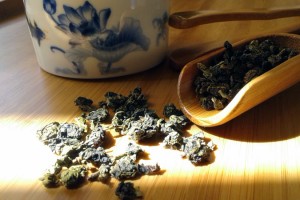
Poorly fermented (or green) oolongs are close to green tea in taste and aroma, green leaves in a dry form, light infusion, yellow - green, taste fresh, sweetish.
Unlike green tea, oolongs are not so demanding on the conditions of brewing, they do not increase the acidity of the stomach, they are neutral in relation to pressure.
Highly fermented oolongs closer to black tea, give a beautiful amber color of infusion, notes of nuts, fruits, baking, honey appear in the aroma.
The aged oolongs, depending on the aging period, acquire a spicy - woody aroma with notes of dried fruits, spices, and spices. In dry form, the leaves are dark brown, the color of infusion from amber to brown.
Production technology
Oolong are made from mature, succulent leaves. Usually used flash (top of the branch with a bud and three to five leaves together with a branch).
Tea flushes are collected and left to dry in the sun for 30-60 minutes.
Then the leaves are placed in baskets and placed in a cool room for further fermentation. Tea farmers are constantly monitoring the process, the raw materials need to be carefully turned and minted, while trying not to damage. For some varieties of oolongs, this process is repeated several times and may take several days.
After that, the leaves are rolled and dried in a special oven at a high temperature, thus preserving the taste, aroma and beneficial properties of this wonderful tea.
But that's not all. After drying, the tea is sorted by hand, separating the cuttings, low-quality and yellowed leaves to get the highest quality tea.
As you can see - the process of producing oolongs is long and laborious. And people who inherit tea skill from generation to generation are engaged in it. Accordingly, the cost of high quality oolongs cannot be low.
Useful properties of oolongs
- Oolong improve digestion, speed up metabolism, help get rid of excess weight, increase immunity, generally rejuvenate and strengthen the body, regulate pressure.
- Oolong contains more than 400 species of chemical compounds useful for the human body. The main ones are: polyphenol compounds, caffeine, vitamins C, D, E, K, B1, B6, B3, B12, calcium, phosphorus, iron, iodine, magnesium, selenium, zinc, manganese, etc.
- Regular use of oolong tea improves the condition of the skin and hair, the figure becomes slimmer, the face is fresh, and, most importantly, the overall psycho-emotional background improves! And everyone knows that a good mood is a guarantee of health!
How to brew oolong
Oolongs, unlike green tea, are not so demanding on water temperature. Since the raw material for the manufacture of oolongs are quite dense mature leaves, they will not be scared even by boiling water, but be humane.
Weakly fermented (green) oolongs are best brewed with soft water at a temperature of 85-95 ° C. Do not insist on green oolong more than 5 minutes - the taste will be bitter and oversaturated.
Highly fermented oolongs can be brewed with boiling water.
Please note that the oolongs of spherical twist due to its density have a rather large weight. Say, 1 gram of oolong Ginseng is about a third of a teaspoon, whereas 1 gram of Wuy Shui Xiang is a teaspoon with a slide.
That is, everything is quite simple - take 1 gram of tea per 100 ml of water, brew, leave for 3-5 minutes and enjoy tea drinking.
But! If you want to get maximum pleasure and benefit from oolong tea and have time for real tea drinking - the best way to brew oolong tea is to brew a “strait”, according to the principle of the tea ceremony Ping Cha or Gunfu Cha.
To do this, do not necessarily go to the courses tea masters. Of course, ideally, you will need tea ware, a tea board, tools, etc. ... but you can get by with the basic, but mandatory attributes: good tea, soft purified water and a smile of your soul :-)
Take a small teapot (150-200 ml), warm it with boiling water, fill it with dry tea for a third of the volume. Drain the first brew - the tea warms up and absorbs moisture. Brew tea without insisting - immediately pour it into a bowl. Thus, you can brew tea 10-15 times, in each brewing opening new notes of taste and aroma. And, of course, enjoy the changes of tea conditions ;-)
Oolong action, tea drunkenness
In addition to the health benefits, oolongs give us a lot of pleasant sensations and tea conditions. First of all, this is a state of harmony, unity with the outside world, a feeling of happiness.
High-mountainous oolongs are extremely rich in L-theanine. This amino acid is a neurotransmitter of the central nervous system responsible for the transmission of impulses between nerve cells. L-theanine contributes to the activation of thinking processes, improves mood, resistance to stress and stimulates the production of the "hormone of happiness" dopamine.
In addition to the dry scientific facts, add on our own - the oolongs captivate with taste and aroma. They can not be disliked - tenderness and freshness, sweetness in the aftertaste of green oolongs ... or intoxicating aroma and exotic of red ... mmmmm ..... try it!
So happiness can still be bought! Among such a variety of oolongs you will definitely find your own. Try, feel, enjoy! :-)
Enjoy your tea with i-tea.club!

Ginseng, ginseng root ... Men in ancient times were looking for different recipes for stimulants of ..

Milk Oolong is one of the most popular Chinese teas. Moreover, when they say the word “oolong”, many..
Te Guan Yin is a tea legend, the king among Chinese oolongs. This tea can be called a visiting card ..

Calm, only calm is Carlson's famous phrase, especially relevant in our time.The dynamics of the life..
Recommended

Tea with ginseng - healing "pebbles" with the addition of milled ginseng root have powerful energy properties and a sweet aftertas..
277 грн.

Milk Oolong - home comfort in every cup! Synonyms: Nai Xiang Jin Xuan, Milk Oolong, Oolong with Milk Flavor Effect: M..
292 грн.

Taiwan Milk Oolong - comfort and impeccable quality in every cup! Synonyms: Nai Xiang Jin Xuan, Milky Oolong, Milky Scent Oolon..
197 грн.

Tie Guan Yin - the famous Chinese Oolong tea with a bright aroma of blossoming lilacs gives unusual tea conditions. Effect: ..
80 грн.

Tie Guan Yin - the famous Chinese Oolong tea with a bright aroma of blossoming lilacs gives unusual tea conditions. Synonyms: T..
179 грн.

Te Guang Yin is China's tea legend. One of the brightest Chinese oolong tea intoxication effect. Farmer Tie Guan Yin with a han..
112 грн.

Roasted Te Guan Yin is a rare black pearl in the treasury of famous oolongs! Synonyms: Tie Guan Yin, Teguanyin, Te Guanyin, Tea G..
180 грн.

Da Hong Pao is a tea legend. But it does not have to be worth all the money in the world. We have found for you the excellent Da H..
250 грн.

Da Hong Pao - the legendary Chinese Oolong tea, gathered in the mountains of Wuyi, is one of the top most expensive teas in the wo..
379 грн.

The younger brother, Da Hong Pao, who has a very similar taste, aroma and properties, will also be pleasantly surprised by the cos..
100 грн.

Kimun is a strong, black, intoxicating, fragrant breath of inspiration from fatigue and depression with a soft "smoke". Synonym..
215 грн.

Warming and hugging evening tea with honey notes of dried fruit for lovers of classic black. Synonyms: Red Yunnan tea, Dian Hon..
141 грн.

Dian Hong - your inspiration and harmony with the heady aroma and rich taste! Dian Hung is autumn! Dian Hoon is a red tea that ..
163 грн.

Golden Brow - delicately curled tea leaf and golden bud. This tea is not only beautiful, it is incredibly tasty and fragrant! ..
138 грн.

Happy Raja - the taste and emotions of childhood! Indian black tea, which returns to childhood not only the taste and aroma, bu..
150 грн.

Assam is the strongest of all Indian teas. About half of the tea produced in India is grown in the Indian state of Assam. The t..
270 грн.

Ceylon black tea - the usual taste and aroma from childhood! Tea grown on the tea island itself. Sri Lanka (Ceylon) is recogniz..
210 грн.

Xiao Zhong - warm embrace of an old friend, coziness and comfort in every mouthful. Effect: warms, improves mood and well-being..
165 грн.