
Umami. The secret of the fifth taste.


- 15 October 2020amEurope/KievThu, 15 Oct 2020 00:00:00 +03002020pThursdayam20
- Views: 8252

A person learns the world around him with the help of five main senses - sight, hearing, smell, touch and, of course, taste. The brain receives complex information, and, according to it, forms an opinion about the benefits or potential hazards of the environment or food (drinks).
We perceive the taste of tea not only by taste buds - in fact, the general opinion about the taste of a drink is made up of incoming signals from all senses. Don't believe me?
If you have never taken part in a real tea tasting, we will tell you how it happens.
Vision

First, the tea is placed in the chahe - a dish for acquaintance with tea. We have the pleasure to examine in detail the dry tea leaf and already get the first idea of its taste - for example, after seeing that tea contains a lot of tea buds (tips) - the brain helpfully prompts that the drink will be sweetish, tender, envelopingly delicious. That is why, for the purity of the experiment, when comparing several types of tea, tea sommeliers practice the so-called "blind" tasting - they taste the already brewed tea, not knowing how it looked in dry form.
The color of the finished infusion can also tell about the taste of tea - a dark, red-brown color will most likely make you expect a tart astringent taste of black tea, while a light, almost colorless infusion will tell about a delicate, soft, exquisite taste of white tea.

The facial expressions of the participants in the tea party can also affect your idea of taste - if one of the guests suddenly grimaces after sipping a drink, you will subconsciously look for bitterness or something unpleasant in the taste.
Hearing

When one of the participants in the tea party characterizes the taste of tea as floral, you, without even trying the drink, are already ready to find the flowery taste, because you have heard about it. Perhaps your taste buds will not agree with this opinion, but they will try to find at least some floral notes in the drink - after all, information about this has been received and the brain has already tuned in to what was expected.
Smell

The aroma of dry tea leaves gives a more or less accurate idea of its taste. For example, the bright aroma of freshly cut green tea grass indicates that the taste will be refreshing, herbaceous, sweetish, while the woody-spicy aroma of Pu-erh tea will indicate a deep, velvety and noble taste, etc.
By the way, tea with an additional aroma (especially artificial) often creates a deceptive impression of the taste.
Touch
You will be surprised, but tactile sensations also evoke certain taste associations. If it is difficult to rub the tea leaf with your fingers, it will most likely taste flat and empty (the tea is probably overcooked). If the tea crumbles into powder with a light touch, it may be too dry, which also does not add to its taste.
However, we will leave these subtleties to the testers, while we ourselves will enjoy the warmth of the cup in our palms, the golden or emerald color of the infusion, the delicious aroma, and, of course, the taste of this noble drink.
Taste

As you know, there are four main tastes - sweet, bitter, sour and salty. The combination of these flavors together with the aroma makes up the flavor bouquet of this or that type of tea.
Oriental gourmets did not find such a limited number of taste characteristics enough, and they added hot (bitter pepper, radish, mustard) and hot to the above tastes. It is difficult to say what kind of taste it is - hot, but we all know that too hot a drink burns the mouth and dulls the sensitivity of taste buds. However, too cold (icy) - too.
So, there are four main tastes. Where did the mysterious fifth taste come from - umami?
In the countries of the Far East (Japan, China), umami is distinguished as a separate, fifth taste. It is difficult to describe in words, it is the taste of protein substances, the taste of amino acids, which are so rich in real tea.
Translated from Japanese, umami means "pleasant taste" or "delicious taste".
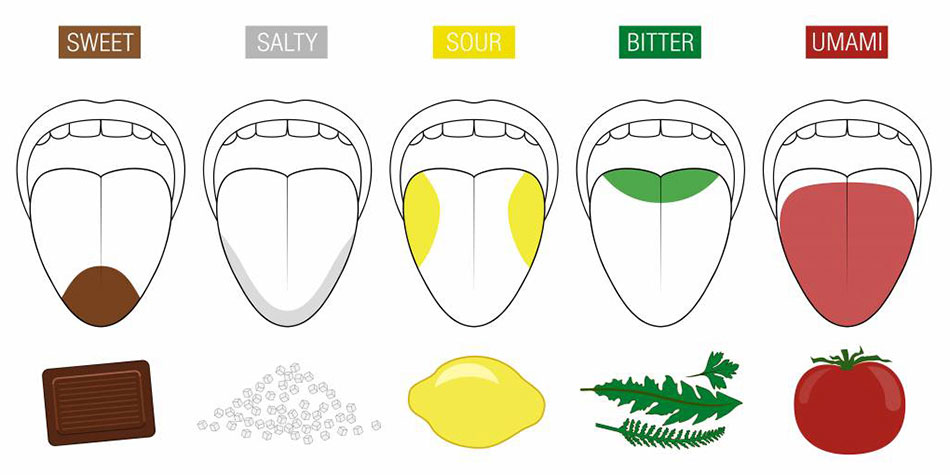
Did you know that there are separate taste buds to recognize each taste? The receptors at the root of the tongue feel bitterness, sweetness at the tip, sour and salty at the edges.
But the receptors that determine the taste of the umami are located on the entire surface of the tongue and are called L-glutamate receptors.
The taste of umami in many products is formed due to the content of monosodium glutamate or E621 in them. It was previously thought that monosodium glutamate does not have its own taste, and it only works as an enhancer of the sensitivity of taste buds, but it was found that there are separate receptors for umami that can perceive only this taste.
Why is the taste of umami so attractive?

Incredibly, we absorbed the taste of umami with mother's milk. Mother's milk is the richest source of glutamic acid. Naturally, at the subconscious level, the mind's taste evokes associations with warmth, comfort, satiety, safety - just like a mother's in her arms.
Green tea is also very rich in this amino acid.
It is noted that the taste of umami is clearly manifested in the varieties of chaI have a high tea bud content such as Silver Needles and steamed teas. Japanese green tea - matcha, gekuro - undergoes this processing.
Summary
Umami - Amino acid flavor, a protein flavor, isolated by the Japanese. The presence of the umami flavor in tea indicates that the tea is rich in amino acids necessary for our health, therefore, it is a delicious and high quality tea.
Drink good tea and be healthy! Enjoy your tea drinking with i-tea.club!

We immediately apologize for the scandalous title of the article - but this is how the question aske..

On the high rocky slopes of the mountain grows a rare plant Sagan-Daile, long known in folk medicine..
Recommended

White Tea Silver Needles - a delicious elixir of health and longevity! Synonyms: Bai Hao Yin Zhen Effect: relieves tension, ..
158 грн.

Tea for geniuses is capable of making any negotiations or a deal as profitable as possible for you with one sip! Synonyms: Gyok..
637 грн.

Included in the list of famous teas in China for a pronounced tonic effect. Synonyms - Huangshan Mao Feng, Shaggy Peaks. Eff..
105 грн.

Tea produced in one of the most northern regions, the special climate of which endowed the tea with an unforgettable floral aroma...
193 грн.

White Peony - gentle and cheerful morning for you! Synonyms: Baymudan, Bai Mu Dan. Effect: gently tones, inspires, harmo..
543 грн.

The May Show is an amazing breath of inspiration! Synonyms: Longevity Eyebrows, Shoumey, Shoumey Effect: inspires, tones, ha..
158 грн.

Bi Luo Chun - the triumph of spring energy. Bi Luo Chun is translated as "Emerald spirals of spring." Green tea, twisted by sma..
215 грн.

Kimun is a strong, black, intoxicating, fragrant breath of inspiration from fatigue and depression with a soft "smoke". Synonym..
215 грн.

Warming and hugging evening tea with honey notes of dried fruit for lovers of classic black. Synonyms: Red Yunnan tea, Dian Hon..
141 грн.

Dian Hong - your inspiration and harmony with the heady aroma and rich taste! Dian Hung is autumn! Dian Hoon is a red tea that ..
163 грн.

Golden Brow - delicately curled tea leaf and golden bud. This tea is not only beautiful, it is incredibly tasty and fragrant! ..
138 грн.

Happy Raja - the taste and emotions of childhood! Indian black tea, which returns to childhood not only the taste and aroma, bu..
150 грн.

Assam is the strongest of all Indian teas. About half of the tea produced in India is grown in the Indian state of Assam. The t..
270 грн.

Ceylon black tea - the usual taste and aroma from childhood! Tea grown on the tea island itself. Sri Lanka (Ceylon) is recogniz..
210 грн.

Xiao Zhong - warm embrace of an old friend, coziness and comfort in every mouthful. Effect: warms, improves mood and well-being..
165 грн.