
We read labels on puer. How to decipher the information on the package

- 08 December 2018amEurope/KievSat, 08 Dec 2018 00:01:00 +02002018pSaturdayam18
- Views: 21740
Many of us are familiar with the situation: you come to the tea shop, you see wide selection of extruded puers and it is often very difficult to choose tea - after all, few people can read Chinese characters.
It is good if you can try tea or at least deploy it to appreciate the appearance of the tea leaf and the aroma of dry tea - but this is not always available, since many puers are packed in such a way that paper packaging cannot be unfolded without damage. It remains only to choose at random, guided by the criteria of price and attractive packaging design.
How to decipher the information left by manufacturers on the pressed tea? Is it as difficult as it seems?
Let's try to figure it out.
In addition to hieroglyphs, there are also numbers on the puerna packaging, though not at all, only in factory puerh.
With numbers, perhaps, let's start. So, for example, let's take this pancake.
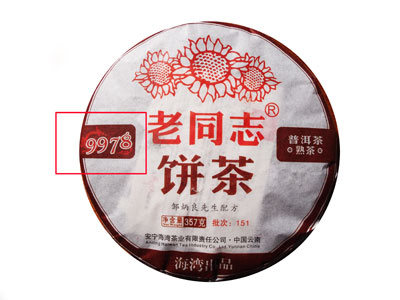
The first two digits are the year when the recipe for making this puer was created. In this case, 1999. Note that this is not the age of puerh.
Pu-erh recipe - certain proportions of mixing different in the region / grade / type of sheet to obtain a characteristic, stable and recognizable taste. To some extent, this ensures that puers from the same factory, produced according to the same recipe in 2008 and 2010, will taste more or less the same. Over the years, new formulations appear, some disappear, but especially successful ones continue to be used.
The third digit, from 1 to 9 - the size, grade of the sheet. The larger the number, the larger the sheet. In our case, 7 means a large, but not as large as possible sheet. The smaller the number, the more tea buds in the composition of this pu-erh, the smaller and more tender the leaf.
The fourth digit is the factory code. In our Pu-erh, the fourth figure 8 is the factory of Hivan.
Factory codes:
1 - Kunming Tea Factory
2 - Menhai Factory
3 - Xiaguan Factory
4 - Factory Feng Qing
5 - Puer Tea Factory (Now Puer Tea Group Co.Ltd)
6 - Six Great Tea Mountains Factory
8 - Haiwan Factory
9 - Langhe Factory
That's how much you can learn from numbers, not knowing Chinese ;-)
What to do if there are no figures on the Puer package, only incomprehensible hieroglyphs?
In fact, there are not so many of them, not everything is so terrible. Let's try to figure out and select the main ones, which are usually found on the packaging of many pancakes or bricks.
Typically, the label highlights the main data:
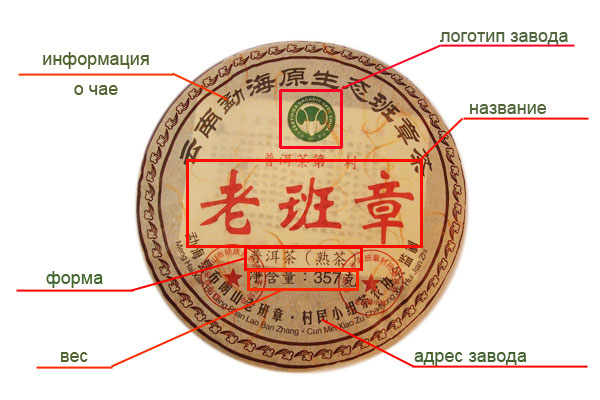
Let us analyze these elements in a little more detail.
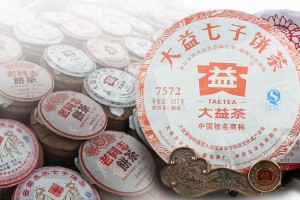
1. The logo, the trademark of the plant - usually it is a drawing on the front side of the cake, which can be used to find out at which factory this puerh was made. Some factories have several brands.
2. The name of Pu-erh is spelled out in big beautiful letters in the center or at the top. Often includes such hieroglyphs as 茶 Cha (tea), Bean (Pancake), Puer.
3. The address of the factory may include hieroglyphs with the name of a locality, such as 勐 海 (Menghai) or 云南 (Yunnan).
4. The main thing to remember from hieroglyphs is the type of puer. As a rule, it is spelled out in the title or in more detailed information about the tea, in large letters, in a circle or in the center. There you will find the hieroglyph Shen сы (raw, green puer) or shu у (black, ready puer).
5. It is not necessary to read the form of pu-erh in Chinese, but you can see it visually - it’s a pancake, a brick or a grinder (the shape of pressing is like a thimble).
6. With weight, too, everything is clear, there are numbers we know)).
So, you and I have almost already learned Chinese ;-) Fortunately, tea suppliers give their names to Puerhs in Cyrillic, from which you can also learn something.
Here is a brief list of combinations of words that are often found in the names of puers:
- Lao is old.
- Bean - pancake.
- Cha - tea.
- Chi Ji Bin Cha - Pancake Seven Sons or Pastry Seven Sons. He says that this Pu-erh was packed for 7 lozenges in tuna, in which it was kept.
- Gu Shu - ancient trees. The manufacturer claims that the leaves and buds from ancient trees served as raw materials for pu-erh.
- Da Shu or Qiao Mu are straight-stemmed trees, not bushes.
- E. Shen - means "wild" and, paradoxically, does not mean that this Pu-erh is raw, Shen Pu-erh.
- Gong Tin - Palace Puerh, such a phrase in the title suggests that the raw materials for the Puerh were the most selective, upper and small leaves and buds.
- Lao Shu - old trees. As in the case of E Shen, it is not necessarily black (shu) pu-erh. For example: Shen Puer "Lao Shu Cha" 2008, Kunming Gui Factory Company.
- Jin I (Jin Hao) - says a large proportion of tea buds in the recipe.
- Lao Cha Tou - Pu-erh in clumps. Sometimes referred to as "Old Tea Heads".
That is, if the Puer is called Jin Ya Gu Shu Chi Ji Bing Cha Ye Shen - do not let this shock you. This only means that the pu-erh has a lot of tea buds, it is collected from ancient wild-growing trees and packed in tuna of 7 pieces each! )))
Summary
Somehow like this. Now, from a seemingly incomprehensible set of numbers, hieroglyphs and letters, we can already make up at least some concept of puer, which we are going to purchase. Of course, ideally, tea should be tried. After all, Pu-erh is an extraordinary tea, he chooses you. But we hope that our modest advice will help you find exactly your Puerh, which will give you the bliss of tea, good health and unforgettable tea conditions!
Enjoy your tea with i-tea.club!

How to brew puer?If you are new to tea making or do not have time for a long tea party - puer can be..

Talk about puerh can be infinite. The point is not only that this is the most "tea", the most Chines..
In our time of mass enthusiasm for pu-erh and their effect, the market is flooded with teas of vario..

We immediately apologize for the scandalous title of the article - but this is how the question aske..
Recommended

Shu Puer Golden Buds - a little holiday every day! The advantages of this shu puer are the high content of the tea bud, which c..
285 грн.

Puer Siaguan T8663 is a prescription shu puer made by one of the most famous tea producers in China - the tea concern "Saguan Toch..
235 грн.

The star of Menhai is one of the best shu Puer of the factory, a reference shu with delicious taste, aroma and tea action for the ..
310 грн.

Shu Puer Old Comrade - a great friendship in a small bowl! Puer of the Haiwan tea factory - a standard of impeccable quality. T..
679 грн.

Shu Puer Menghai Da Y 2019 heady aroma from the Menghai Tea Factory. The Menghai Tea Factory is the flagship of China's puer in..
245 грн.

The king of tall trees is famous for his ability to give incredible tea fortunes! Shen Puer Qiao Mu Wang (King of Tall Trees) i..
411 грн.

Sheng Puer Menghai Da Yi Platinum Tile is a precious ingot in the tea treasure! Luxurious Sheng from Menghai Tea Factory. The r..
180 грн.

Shen Puer Xiaaguan Gold Ribbon 2017 - green puer in the form of Tochi. A golden ribbon is pressed inside the tea, which is a kind ..
310 грн.

Kimun is a strong, black, intoxicating, fragrant breath of inspiration from fatigue and depression with a soft "smoke". Synonym..
215 грн.

Warming and hugging evening tea with honey notes of dried fruit for lovers of classic black. Synonyms: Red Yunnan tea, Dian Hon..
141 грн.

Dian Hong - your inspiration and harmony with the heady aroma and rich taste! Dian Hung is autumn! Dian Hoon is a red tea that ..
163 грн.

Golden Brow - delicately curled tea leaf and golden bud. This tea is not only beautiful, it is incredibly tasty and fragrant! ..
138 грн.

Happy Raja - the taste and emotions of childhood! Indian black tea, which returns to childhood not only the taste and aroma, bu..
150 грн.

Assam is the strongest of all Indian teas. About half of the tea produced in India is grown in the Indian state of Assam. The t..
270 грн.

Ceylon black tea - the usual taste and aroma from childhood! Tea grown on the tea island itself. Sri Lanka (Ceylon) is recogniz..
210 грн.

Xiao Zhong - warm embrace of an old friend, coziness and comfort in every mouthful. Effect: warms, improves mood and well-being..
165 грн.