
Sung bowls. Pottery of the Song Dynasty

- 27 February 2019amEurope/KievWed, 27 Feb 2019 00:01:00 +02002019pWednesdayam19
- Views: 13574

Chinese porcelain is famous all over the world for its beauty and elegance of forms, variety of patterns and colors. Representing Chinese porcelain, we usually see thin, translucent, light-colored dishes that let in sunlight. The English word porcelain - "porcelain" comes from the Italian "porcella" - so called white seashells.
A method of making such porcelain for thousands of years was kept by the Chinese in secret and was discovered by Europeans only at the beginning of the 18th century. Therefore, Chinese porcelain for centuries was one of the most expensive and popular among the nobility of goods in Europe and in the East. The uniqueness of Chinese porcelain was in white clay - kaolin used in production. Clay products were burned at a temperature of 1280 degrees Celsius in special kilns, after which the clay became slightly transparent and waterproof.
But the Sung period was a real breakthrough in the manufacture of Chinese ceramics. A completely new method of burning the finished product and applying enamel was invented. Did you know that the English word "china" means both "China" and "china"? In Arabic, the meaning of the word "porcelain object" means "Chinese", "from China." Ie porcelain is one of the greatest achievements of ancient China, even the name itself is associated with the name of the country of origin. Porcelain products, along with tea, were given to representatives of foreign delegations, thus strengthening friendship between nations, China’s communication with the outside world was strengthened, and Chinese culture was spreading.
Song (Song) and Yuan dynasties became a turning point in the rooting of porcelain. It was then, in the cities everywhere began to appear furnaces used for the manufacture of fanfare products. New variations of painting, forms and methods of application began to appear. In porcelain products began to insert valuable metals, precious stones. At this time, the technology of roasting porcelain products reached a certain perfection, and a special technology of applying colored glaze was invented, which was kept secret for many years. It was during this period, in the 11th century, that an innovation in the production of ceramic products, a completely new, unconventional approach to the manufacture of drinking tea bowls, appeared.
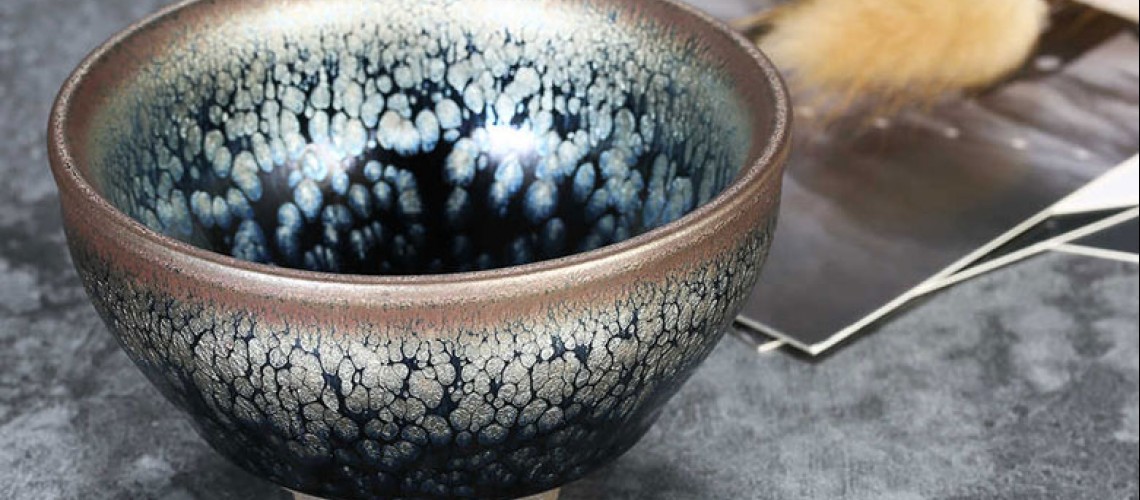
Sung bowls are unique in that liquid glaze spreads randomly along the walls, creating a unique pattern in each piece. Liquid valuable metals were added to the glaze. As a result, completely unique drawings are created, there cannot be two identical drinking cups. This technology is called "temmoku ceramics". Tammoku in China was very much appreciated for its thick walls, which slowly gave off heat and for the beautiful patterns, iridescent with all the colors of the rainbow.
Sun porcelain is truly priceless. For example, in 2004, a product was sold for writing from Sung porcelain, the cost of which was 10 million yuan (about 40 million hryvnia).
Later, in the period of the XII to the XVI century, the Japanese adopted the technique. The word “Tammoku” is the Japanese interpretation of the name of the Chinese mountain Tianma [en] (Chinese 天 目, pinyin: tiānmù), where the monks used ceramics with similar glazes for tea utensils, and where Japanese monks met them. The Chinese name for this variety of ceramics is jian [en] (Chinese 建, pinyin: Jiàn from the Jianyang region [en] in Fujian), it came to Japan in the Middle Ages, it was imported a lot during the Kamakura and Muromachi periods (1185-1573) . Japanese products were very similar to the original Chinese, but they used different clay, glaze and manufacturing techniques. In Japan, there was no raw material rich in iron, as in Fujian clay. Therefore, the Japanese potters had to add iron-containing powder to ceramics to achieve dark colors. A distinctive feature of the Japanese tammoku was the form: the Chinese bowls had many different forms, while the Japanese - mostly trapezoidal in section, with a narrow bottom and a wide mouth, the rim slightly curved outward.
There are several basic techniques in the manufacture of Tammoku ceramics. Most appreciated pattern, like oily stains. When light hits the surface of such a product, a teal (tea cup) reflects it with a flash of multicolored rays from green to purple.
Another valuable effect is called "rabbit fur", it is, like "oily spots", the result of the separation of the glaze during firing, but it is easier to achieve. There are two types of hare fur: light spots that look like contrasting hairs on hare fur, and fuzzy wavy lines that resemble undercoat.
Of course, we will not argue that the Sung bowls in our store collection were made in the 11th century, but it is always a pleasure to hold a decent counterpart at the right price in your hands, to admire and enjoy tea.
Enjoy your tea with i-tea.club!

A teapot with a button, a gunfu teapot, a teapot for the strait, a tip, a tea master - these wonderf..

A kettle is the main attribute of tea drinking. After good tea, of course. What is needed to prepare..
Recommended

The most beautiful porcelain bowl Thin, transparent porcelain. The embossing depicts the excitement of the sea, flying seagulls..
390 грн.

Thin carved porcelain bowl Delicate transparent porcelain. Embossed with traditional Chinese landscape painting. Glows in th..
330 грн.

A unique bowl with a beautiful pattern Volume 50 ml Origin: Dehua The peculiarity of pouring glaze is that the te..
135 грн.

A unique bowl with a beautiful pattern Volume 50 ml Origin: Dehua The peculiarity of pouring glaze is that the te..
135 грн.

Bowl made of Yixing clay Zi Sha. Volume 50 ml An elegant small earthenware bowl. Quite an unusual cylindrical shape, narrowed i..
285 грн.

Porcelain bowl with a crane Volume 75 ml Origin: Dehua An exquisite bowl made of fine porcelain. Glows in the light. Comf..
180 грн.

Thin porcelain bowl White transparent porcelain. Embossing is a painting from the Song Dynasty - “Qingming Festival” (Festival ..
390 грн.

Kimun is a strong, black, intoxicating, fragrant breath of inspiration from fatigue and depression with a soft "smoke". Synonym..
215 грн.

Warming and hugging evening tea with honey notes of dried fruit for lovers of classic black. Synonyms: Red Yunnan tea, Dian Hon..
141 грн.

Dian Hong - your inspiration and harmony with the heady aroma and rich taste! Dian Hung is autumn! Dian Hoon is a red tea that ..
163 грн.

Golden Brow - delicately curled tea leaf and golden bud. This tea is not only beautiful, it is incredibly tasty and fragrant! ..
138 грн.

Happy Raja - the taste and emotions of childhood! Indian black tea, which returns to childhood not only the taste and aroma, bu..
150 грн.

Assam is the strongest of all Indian teas. About half of the tea produced in India is grown in the Indian state of Assam. The t..
270 грн.

Ceylon black tea - the usual taste and aroma from childhood! Tea grown on the tea island itself. Sri Lanka (Ceylon) is recogniz..
210 грн.

Xiao Zhong - warm embrace of an old friend, coziness and comfort in every mouthful. Effect: warms, improves mood and well-being..
165 грн.